Electric BMW M3 Prototype Hits the Track With Four Motors and 838 HP
/BMW M has started showing the world its next M3, and it is fully electric. In mid-November, BMW invited journalists to its Miramas test center in southern France to drive camouflaged prototypes on track. BMW calls the car the fastest and most powerful M3 it has ever built, and the early figures back that up.
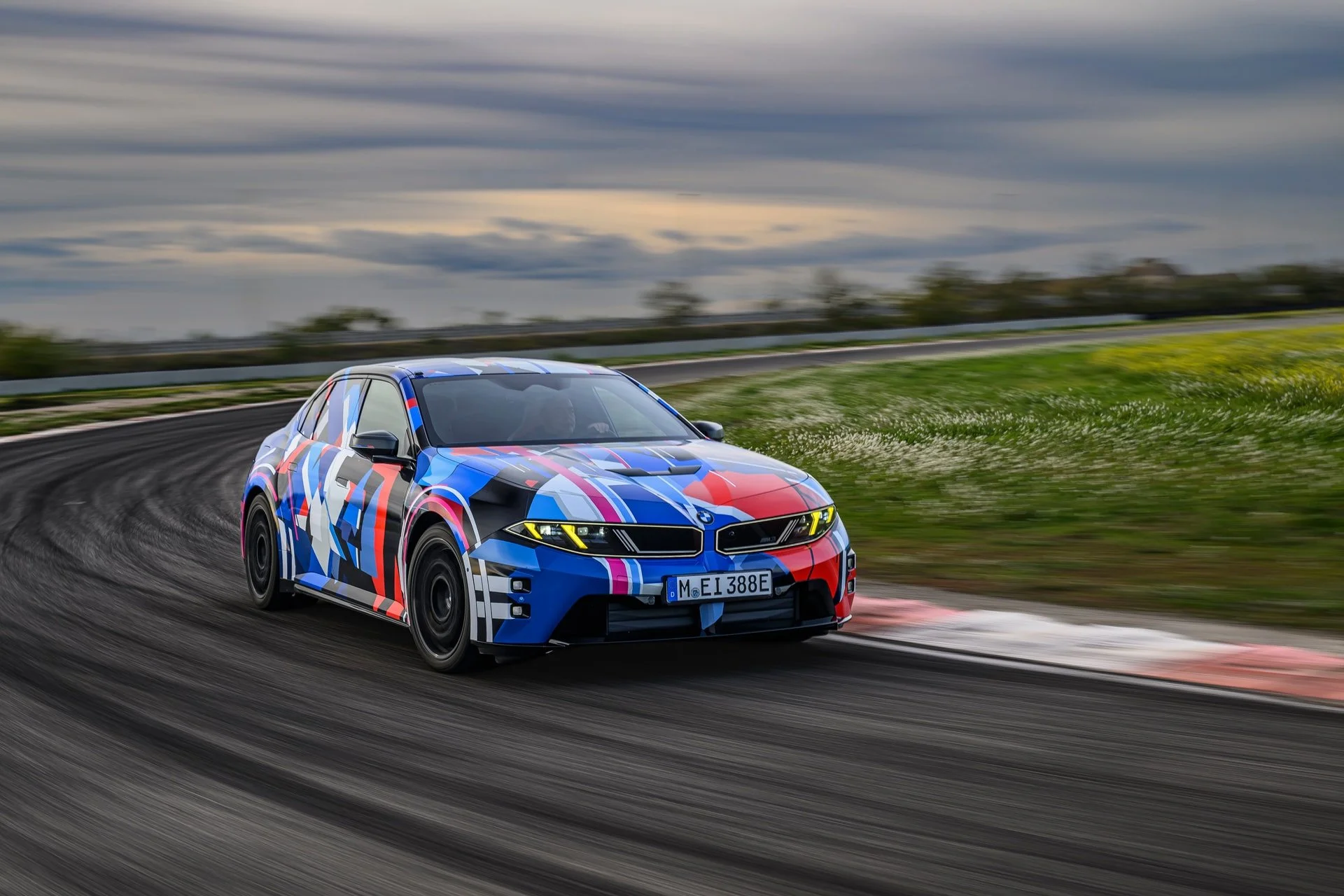
Photo: BMW Group. A camouflaged prototype of the new fully electric BMW M3 at Miramas, France.
Four motors, one for each wheel
The new M3 uses four electric motors, two on each axle. BMW calls the system M eDrive, and it grew out of the M xDrive all-wheel drive used in current M cars. It is set up with a rear bias, and in normal driving the car runs in rear-wheel drive, with the front axle joining in when it is needed. On longer trips the front axle can be decoupled to save energy.
The preliminary numbers are big. The front motors make about 644 hp and 398 lb-ft, and the rear motors about 751 hp and 738 lb-ft. Combined output is at least 838 hp and 885 lb-ft of torque. The extra capacity at each axle is there for torque vectoring, front to rear and side to side. A single control unit that BMW calls the "Heart of Joy" runs M Dynamic Performance Control and manages each motor on its own, using steering, throttle and brake inputs.
A battery built for the track
The M3 gets its own version of BMW's sixth-generation battery, with about 100 kWh of capacity and an 800-volt system. It has extra cooling so it can hold peak power for longer. BMW quotes fast charging at up to 420 kW, which adds about 217 miles of range in 10 minutes, and estimated EPA range is around 300 miles. Regenerative braking can recover up to 540 kW. Motor1 reports that after three laps of a track, the M3 can recover about one lap's worth of energy. The battery also bolts directly to the front and rear subframes, which makes the body stiffer.
All of these figures are provisional and may change before production.
Built to feel like an M3
BMW clearly wanted the car to involve the driver. In Auto mode, M eDrive gives the car six "stages" that act like gears, with M eSound raising and lowering the engine-style sound as you move through them. A paddle mode lets the driver shift manually, with shift lights and a limiter. Off gives a smooth, single-speed EV feel. Preset Track settings range from Hot Lap to Long Run for steady performance on a circuit.
The early reviews were enthusiastic. Car and Driver said the car "really did feel like an M3." Motor1 titled its review "The Real Deal," and BMWBlog wrote that it feels like a real M3.
The prototype also shows a few design details. It has M Yellow daytime running lights, wider fenders over Michelin Pilot Sport S 6 tires, and square front marker lights that recall the E30 M3. In place of some carbon fiber, BMW is using a natural-fiber composite developed in motorsport. BMW says making these parts creates about 40 percent less CO2e.
What's next
BMW plans to unveil the finished car in January. A gasoline-powered M3 is also on the way, so M3 fans will have a choice of both. Until then, if you want to keep your current BMW's navigation up to date, see our BMW navigation map updates.
Source: BMW Group Newsroom, BMW Group, Car and Driver, Motor1, BMWBlog and Carscoops.